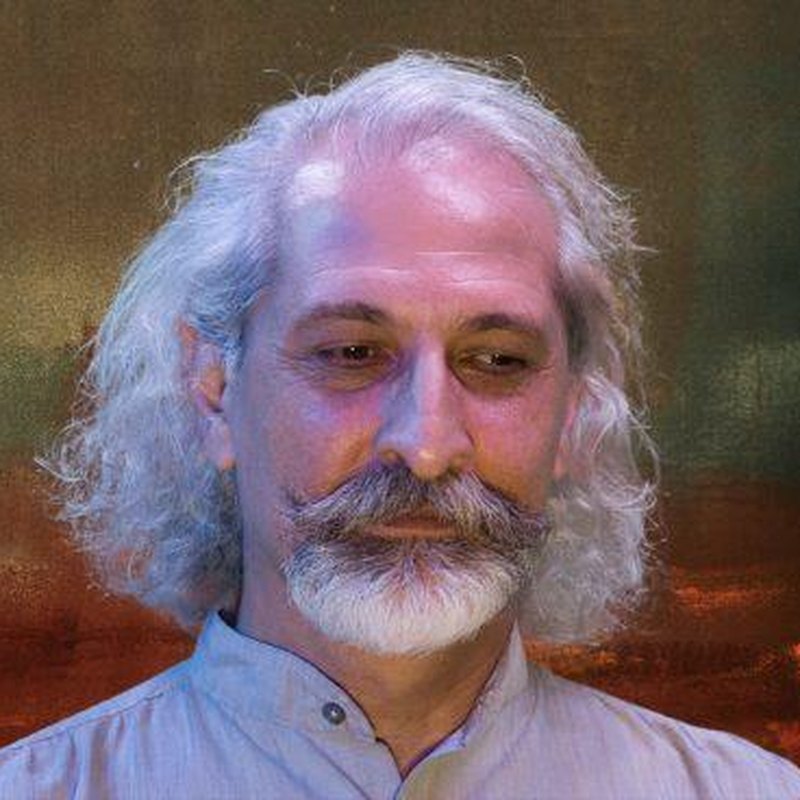
Yari Ostovany
Yari Ostovany was born in Iran in 1962. He grew up in Tehran and moved to the United States at sixteen, shortly before the 1979 revolution. He took a BA in Art at the University of Nevada, Reno in 1990, then a BFA in 1992 and an MFA in 1995, both in painting, at the San Francisco Art Institute. He has worked in the Bay Area since the early 1990s.
His work is held by the New Britain Museum of American Art in Connecticut, the John and Geraldine Lilley Museum of Art in Reno, the Pasargad Bank Museum in Tehran, and the Chateau d'Orquevaux in France, where he spent a month-long residency in the autumn of 2018.
He works in oil, acrylic, alcohol ink on Yupo paper and occasionally gold leaf. Paintings begin with calligraphic gestural marks that then dissolve, built through layers of thick and thin washes and glazes, luminous and opaque, added, rubbed out, re-applied, scoured into and scraped away. He works on many pieces at once at different speeds; some take days and some take years.
In his own words: I regard Caravaggio and Rothko as much my artistic ancestors as I do the tile makers of the Safavid era.
His series are named after Attar, Shams of Tabriz, Haydn, Bach, Goya, the forty-day retreat of the Sufi orders and the Zen koan. He is explicit that this is not illustration. Never in the way of illustrating an idea or a concept, he says, but allowing it to wash over me.
In the artist’s words
My work is process based and improvisational, straddling the nebulous realm between the mystical and the mysterious and thus, to me, the spiritual. A personal journey of exploration through the alchemy of paint, color, light, texture and the poetics of space.
I approach painting as the visual evidence of, and not a report on, an experience; not a representation of spiritual energy but a translation of it into light and texture, navigating the space between stasis and movement, between emergence and disappearance.
I see abstraction as representational insofar as it is a representation of a psychic state, not an external reality. The trajectories in contemporary painting in which my work belongs range from Abstract Expressionism in the west to Persian and Taoist/Zen aesthetic sensibilities in the east and other perennial visionary paths of wisdom.
Series
Conference of the Birds
1997 to present
Attar of Nishapur wrote Mantiq al-Tayr around 1177. The birds of the world assemble to find their king and set out across seven valleys: Quest, Love, Knowledge, Detachment, Unity, Bewilderment, and Annihilation. Most turn back. Thirty arrive, and find no king waiting for them. They find themselves. The Persian carries the pun Attar built the poem around: si morgh, thirty birds, against Simorgh, the bird they went looking for. It is wordplay rather than etymology. The name actually descends from the Middle Persian senmurw. Ostovany has painted this series since 1997, which makes it the longest running body of work in his catalogue. He glosses the Simorgh as the phoenix and reads the ending as the reward of those who persevered.
Chelleneshin
2010 to present
Chehel is forty in Persian. Chelleh is any forty day span, neshin is sitting. The chelleneshin is the practitioner of a forty day retreat: a room sealed against light and sound, fasting, near total isolation, constant remembrance. Suhrawardi grounded the practice in the forty nights of Moses. Ostovany describes it as spiritual seekers entering solitude for forty days and nights, a cycle he says represents the duration needed for transformation. Two things are worth knowing. Rumi objected to the practice as an innovation, and it has effectively vanished from Sufi orders in modern Iran, so this is a literary reference rather than an observed one. The same word for forty also names Shab-e Chelleh, the longest night of the year. Ostovany does not draw that connection; we mention it as context.
The Third Script
2008 to present
Shams of Tabriz: the writing comes in three scripts, one that he alone can read, one that he and others can read, and one that neither he nor anyone else can read. I am that third script. The line is from the Maqalat, the Discourses of Shams. Students had asked him for Quranic exegesis and he answered with a calligrapher''s analogy, putting his own speech in the third category. Read in context it is an admission of incomprehensibility rather than a boast. The popular Iranian reading descends from Naser-al-Din Saheb-al-Zamani''s Khatt-e Sevvom, published in the early 1970s, and scholars treat it as a reduction. Ostovany follows the popular version. He dates the series to the 1244 meeting of Rumi and Shams in Konya, which turned a respected jurist into a poet. The two, he writes, found in each other the indescribable third script.
Numinous
2003 to present
Rudolf Otto coined das Numinose in Das Heilige in 1917, from the Latin numen, divine presence. He used it for the non-rational core of religious experience: mysterium tremendum et fascinans, a mystery at once dreadful and irresistible. Ostovany gives only the dictionary definition on his own site and does not name Otto. This is his largest and least unified series, and the place his syncretism shows most plainly. Sanskrit titles sit beside Zen ones, Sufi beside Shakespearean: Satya Bagecha, The Bodhi Tree, Hallaj, Prospero, Sutra, Cathedral, and one canvas for Gurdjieff.
Fragments of Poetry and Silence
2012 to present
The phrase is his own. The series carries a poem by John Berger: in a pocket of earth I buried all the accents of my mother tongue, there they lie like needles of pine assembled by ants. Berger recurs across Ostovany''s catalogue more often than Rumi or Attar. Here Is Where We Meet, four paintings called The Passeur, By Photograph or by Train. Individual works in this series are dedicated to Hafez, Pound, Eliot, Lorca, Rilke, Tarkovsky, Arvo Part, Kundera, Neruda and Tapies.
Night Pilgrim
2016 to present
The epigraph is Sri Aurobindo: I made an assignation with the night, in the abyss was fixed our rendezvous. Aurobindo was an Indian nationalist who became a yogi and a poet. His presence here is a reminder that Ostovany''s frame is comparative rather than specifically Islamic.
The Oracle
2016 to present
The epigraph is Lawrence Ferlinghetti: great Oracle, sleeping through the centuries, awaken now at last and tell us how to save us from ourselves. This series holds his largest canvases. The Oracle X is 82 by 62 inches. It is the public address register of his work.
Peregrine
2014 to present
His own gloss, in full: peregrine, from the Latin peregrinus, foreign, from peregre, abroad, from per, through, and ager, field. Foreign, alien, wandering, migratory. He defines the word rather than the bird. The same root gives English pilgrim. Ostovany left Tehran at sixteen, shortly before the 1979 revolution, and this series sits alongside Night Pilgrim, The Crossing and Wanderer''s Hymn. He has not said the connection is deliberate.
Cantata
1994 to present
Ostovany: the Cantata series is an homage to Johann Sebastian Bach. It is the only series with a named dedicatee. It absorbs his other musical forms: Toccata, Chaconne, Fugue for the Wanderer, Nocturne for Chopin, and Partita for a broken violin, written for Ukraine in 2022. Fermata I, from 1994, is the earliest dated work anywhere in his catalogue.
Koans
2015 to present
His definition: paradoxes to be meditated upon, used in Zen Buddhism to break through and directly perceive reality with the wisdom eye. The series includes The Ship of Theseus, Plutarch''s paradox about the vessel whose planks were replaced one at a time until none of the original remained. Ostovany files a Greek problem under a Zen heading, which treats it as something to sit with rather than something to solve.
Missa in Angustiis
2016 to 2024
Haydn''s Mass No. 11 in D minor, written in 1798. He called it Missa in angustiis, mass in times of distress. Napoleon''s armies had beaten Austria four times in a year. It premiered as news arrived that Nelson had destroyed the French fleet at the Nile, which is how it picked up the nickname Nelson Mass. Coincidence, not dedication. Ostovany takes the title. The epigraph on his own page is not Haydn but T. S. Eliot''s Burnt Norton.
The Education of Icarus
2023 to present
The epigraph is William Carlos Williams: according to Brueghel, when Icarus fell it was spring. The series gathers myths of overreach and futile labour. Icarus, Daedalus and his seven plans for the labyrinth, Atlas, Sisyphus. The Williams poem is about the world''s indifference to the fall.
The Poet
2017 to present
The epigraph is Gerald Stern: I lay forever, didn''t I, behind those old windows listening to Bach and resurrecting my life. The series contains The Blind Poet, an epithet with several possible owners: Homer, Milton, al-Maarri, or Rudaki. Ostovany has not said which he means and we are not going to guess. It also contains The Last Poet in Kyiv, painted in 2022.
Letters From Quarantine
2020
Ostovany: then came Covid-19, and these paintings on paper were done during, and are a visceral response to, the pandemic lockdown in 2020. Every work is dated 2020 and almost all are 15 by 11 inches on paper. The constraint is visible in the format. There are no studio scale canvases in the run.
The Orquevaux Paintings
2018
In the autumn of 2018 Ostovany spent a month at the Chateau d''Orquevaux in Champagne-Ardenne, working out of the chateau''s former stables. Twenty-two canvases came out of it, all acrylic, all dated 2018. He describes it as an incredibly soul nourishing time that allowed deep, uninterrupted and sustained focus on the connections between Eastern and Western approaches to abstraction. The chateau holds Orquevaux 22 in its permanent collection. This is the only concentrated, dated, single location body of work in his catalogue.
Rebuilding Goya
1999 to 2003
Ostovany: the Rebuilding Goya series is an homage to Francisco Jose de Goya y Lucientes. That is his entire statement. He does not say which Goya, and neither will we. Twenty-four works between 1999 and 2003, mostly oil on paper. His earliest series and the only one he has closed.
Soliloquies
2018 to present
An act of speaking one''s thoughts aloud when by oneself, or regardless of any hearers. Every one is a six inch square panel. The form governs the scale.
Verses
2015 to present
Verse, from the Old French vers and the Old English fers, both from the Latin versus, meaning a row or a line. A stanza, a metrical unit, one line of a poem.
Tributes/Hommages
1994 to present
Ostovany: over the years there have been some who have touched my heart and soul deeply, some by their presence and others through their art, and these pieces are my way of offering my gratitude. Overwhelmingly composers. Beethoven six times, then Arvo Part, Keith Jarrett, Mahler, Berlioz, Stravinsky, Schoenberg, Satie, Scriabin, Cage, Chopin, Zakir Hussain, Shajarian and Jan Garbarek.
Nova Concordia
2019 to present
Over forty canvases, all acrylic. Ostovany has published no statement on this series.
Works on Paper
2023 to present
Sonnets, Rhapsody, The Offering and other works on paper, most of them around 12 by 9 inches.
Available works
All 696 →Yari Ostovany
Sonnet 7, 2024
oil on paper · 12.2 × 9.25 in
$700
Yari Ostovany
The Oracle XXVI, 2024
oil on canvas · 30 × 30 in
$3,100
Yari Ostovany
Brahmamuhurtha 3, 2024
oil on canvas · 16 × 20 in
$1,700
Yari Ostovany
Peregrine 43, 2024
oil on canvas · 20 × 16 in
$1,700
Yari Ostovany
Soliloquy 2, 2024
oil on panel · 6 × 6 in
$250
Yari Ostovany
Resurrection (for Gustav Mahler), 2024
oil on canvas · 40 × 90 in
$13,000
Yari Ostovany
Chelleneshin 52, 2024
oil on canvas · 39 × 38.5 in
$5,300
Yari Ostovany
Arbour Zena 4 (for Keith Jarrett), 2024
oil on canvas · 36 × 36 in
$4,200
Yari Ostovany
Night Pilgrim 35, 2024
oil on canvas · 20 × 16 in
$1,700
Yari Ostovany
Cantata 25, 2024
oil on canvas · 10 × 8 in
$600
Yari Ostovany
Requiem for a Friend 2, 2024
oil on canvas · 4 × 12 in
$350
Yari Ostovany
Aurora, 2024
oil on canvas · 30 × 30 in
$3,100